
Why Do Dogs Spin Before They Poo? (And 7 Other Funny Bathroom Habits Explained)
Why Do Dogs Spin Before They Poo? (And 7 Other Funny Bathroom Habits Explained)

1. Why Do Dogs Spin Before They Poo?
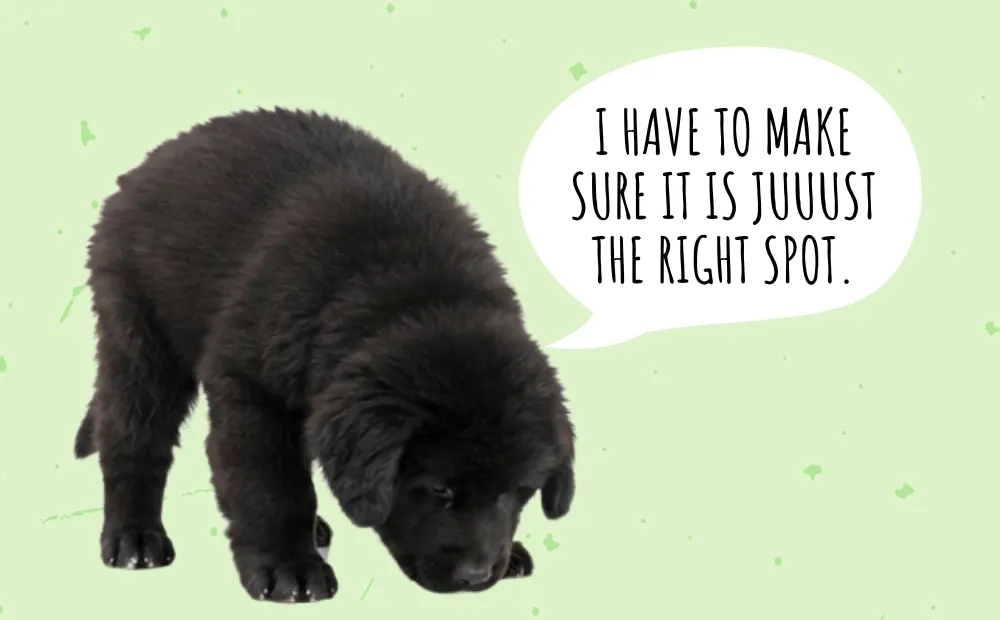
That pre-poo pirouette may be your dog’s way of settling in and selecting a spot that feels right. Common theories suggest wild canids may have circled to flatten the grass or check for danger before squatting, though it is difficult to prove any one motive in an individual dog. A particularly fun theory says dogs may orient themselves with Earth’s magnetic field. One observational study reported a North–South alignment preference during calm magnetic conditions, but a later study did not reproduce that result. [1] [2]
In other words, magnetic potty positioning is an entertaining possibility, not a settled explanation. Your dog may simply be taking a moment to get comfortable—because apparently choosing a bathroom spot is serious business.
2. Why Does My Dog Kick Grass After Pooing?

The dramatic backward grass kick is usually not an attempt to bury the evidence. It may leave a visible scuff and spread pedal scent from the paws. Researchers have shown that dogs can recognize scent collected from other dogs’ feet, although exactly how every dog uses that information is still being studied. [3]
Think of it as a tiny, scented yard announcement: “Paws were here.”
3. Why Does My Dog Sniff Other Dogs’ Poo?
To us, it is a hard pass. To a dog, it is neighborhood news.
Dogs rely heavily on scent to explore and communicate, so a sniff at a scent mark can offer clues about the animals that have passed through an area. [4] While some fun ideas suggest a dog can instantly read another dog's exact age, diet, and stress levels from a single sniff, it is more accurate to call poo a scent-rich record that tells them who has been visiting their territory.
4. Why Does My Dog Stare at Me While Pooing?
Yes, this can feel awkward. No, your dog is not judging your life choices.
Veterinary behavior guidance offers several possible explanations: your dog may be checking in with you for reassurance, watching your body language, remembering potty-training rewards, or looking for approval. [5] Some experts suggest they are looking to you for protection because they are in a vulnerable position. Every dog is different, so it is best to treat that intense gaze as a likely check-in—not a universal request for bathroom security.
5. Why Does My Dog Get the Zoomies After Pooing?

Some dogs finish their business and immediately take off like they have been launched from a cannon. These bursts of energy are often called frenetic random activity periods, or FRAPs—better known as zoomies.
There is no single known cause of zoomies, but they can happen after a poo and may be linked with excitement, releasing pent-up energy, or just a simple feeling of relief. [6] If your dog is loose-bodied, bouncy, and clearly having fun, enjoy the show from a safe distance.
6. Why Won’t My Dog Poo in the Rain?
When it is raining, some dogs suddenly act as if the backyard has become forbidden territory. Possible influences include wet paws, altered scents, wind, rain noise, and a disrupted routine—any of which can make a familiar potty break feel less appealing. The exact reason varies from dog to dog.
For dogs who are frightened by storms, keep the outing calm, brief, and reward-based. Do not punish a dog for being afraid; veterinary behavior guidance recommends gentle behavior-modification approaches for storm fears. [7]
7. Why Does My Dog Take Forever to Find the Perfect Spot?
What looks like endless wandering may be a very thorough sniff-and-select process. Dogs use scent as a major way to assess their surroundings, so the final decision can involve more information than we can see—or smell. [4] They might be evaluating lingering scents, ground texture, and whether the area feels safe.
A little patience goes a long way. Your dog is not trying to make you late; they are just conducting a highly important field investigation.
8. Why Does My Dog Always Poo in the Same Spot?
Many dogs develop a favorite bathroom location. Familiar smells, a predictable routine, and a spot that has worked before can make one corner of the yard especially appealing. It may also give them a chance to reinforce their own scent markers. If your dog has a go-to place, congratulations: they have created a personal restroom with excellent repeat business.
When to call the vet: Quirks are one thing; sudden or uncomfortable changes are another. Contact your veterinarian if your dog is straining, appears painful while pooing, has diarrhea, shows blood in the stool, becomes lethargic, or has other persistent bathroom changes. [8]
The One Bathroom Habit We Can Control
Your dog may never stop spinning, sniffing, kicking, or zooming. The cleanup, however, is the part we can make easier.
PooPail brings the scooper and outdoor poo bin together in one backyard-friendly system. Its long handle and 4-gallon capacity are designed to make everyday pickup easier, while the lid is built to help contain odor and keep out water and flies.
Your pup can keep the potty-time rituals. You can keep the yard routine simple →
Resources and Further Reading
Sources
[1] Hart et al. (2013), Dogs are sensitive to small variations of the Earth's magnetic field — PubMed: https://pubmed.ncbi.nlm.nih.gov/24370002/
[2] Rouvière & Ruxton (2022), No evidence for magnetic alignment in domestic dogs in urban parks — Journal of Veterinary Behavior: https://www.sciencedirect.com/science/article/abs/pii/S1558787821001696
[3] McClanahan & Rosell (2020), Conspecific recognition of pedal scent in domestic dogs — Scientific Reports: https://www.nature.com/articles/s41598-020-74784-5
[4] VCA Animal Hospitals, How Dogs Use Smell to Perceive the World: https://vcahospitals.com/know-your-pet/how-dogs-use-smell-to-perceive-the-world
[5] VCA Animal Hospitals, expert advice on dogs staring during a poo: https://vcahospitals.com/resources/behavior-dog/why-do-dogs-stare-at-you-while-they-poop
[6] Cornell University College of Veterinary Medicine, What are zoomies?: https://www.vet.cornell.edu/departments-centers-and-institutes/riney-canine-health-center/canine-health-information/what-are-zoomies
[7] VCA Animal Hospitals, Helping Dogs with Severe Phobias During Storms and Fireworks: https://vcahospitals.com/know-your-pet/helping-dogs-with-severe-phobias-during-storms-and-fireworks
[8] Merck Veterinary Manual, Disorders of the Rectum and Anus in Dogs: https://www.merckvetmanual.com/dog-owners/digestive-disorders-of-dogs/disorders-of-the-rectum-and-anus-in-dogs
[9] PooPail, product features and use: https://poopail.com/


Facebook
Instagram
Youtube